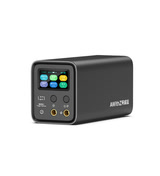
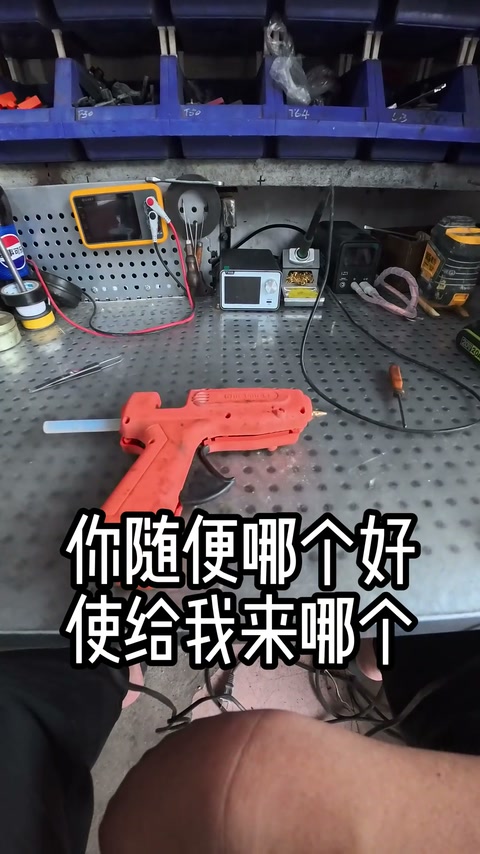
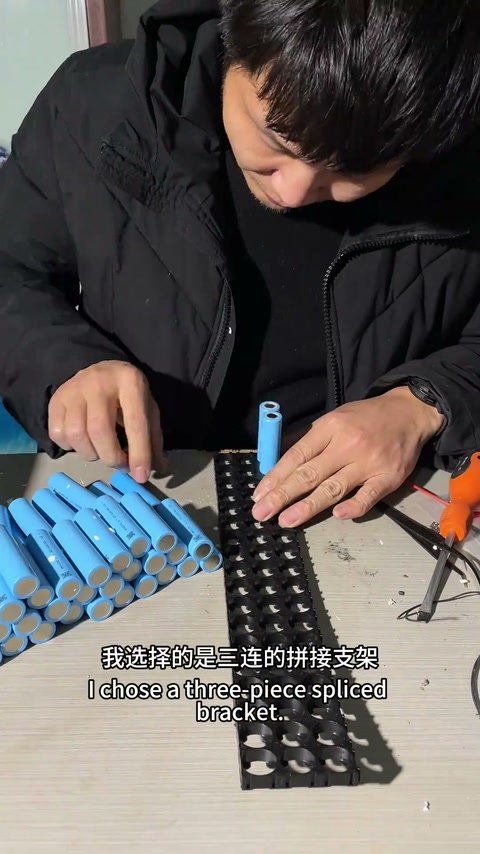
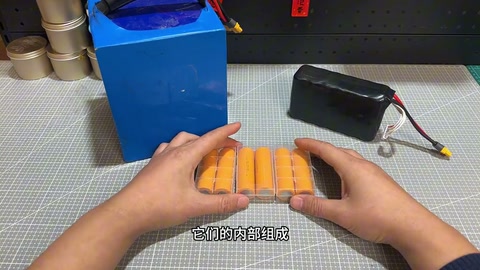
A follower asked whether the AWithZ UF20B can weld copper stacked directly; I said probably not, he said support says it can with flux. Fine — if you don’t believe me, don’t ask me again, the video is right here, see for yourself. The welder is the AWithZ UF20B from my showcase, upgraded No. 6 welding pen: copper straight on vs copper on a nickel base. Also found some followers haven’t even figured out nickel base layers… mainly I turned the power bank into a 30000mAh one, and it’s a joy





Creator’s own settings as stated in the video (timestamps link to the moment). Not official values — test on scrap first.
Bill of materials
Welder, accessories, consumables and parts used in this build; quantities and specs are editable Download BOMDescription
Lefeng answers ‘support says the UF20B can weld copper directly (with flux)’: two Jiashikai cells in parallel make a 30000mAh LiFePO4 power bank (new board ¥20-odd), 0.1 copper + 0.1/0.12 nickel-plated straight on — gear 70 spots look pretty but drop off with a tug, gear 90 four spots still not solid; switch to a 0.15 nickel-plated base, gear 30 already solid, 40 tears, 60 can’t be pulled, ‘don’t recommend copper straight on with this model’; B1/B− to the board, sealed with epoxy board + glue, like a single big cell super-fast-charging power bank
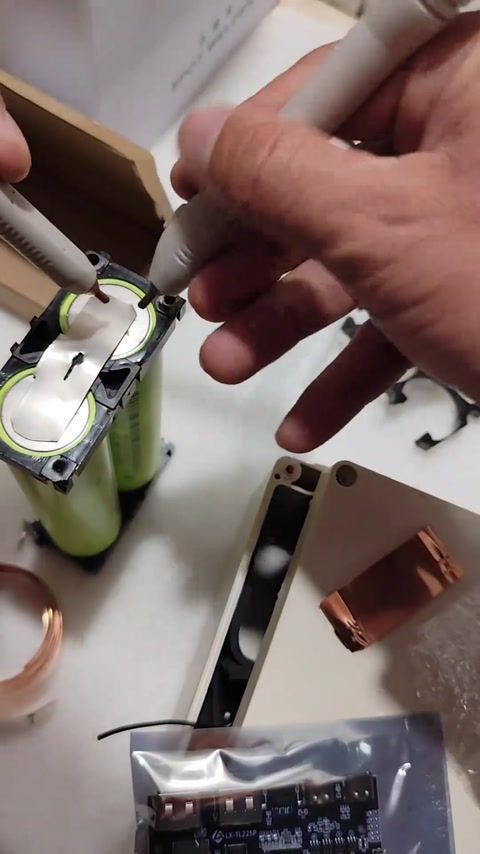
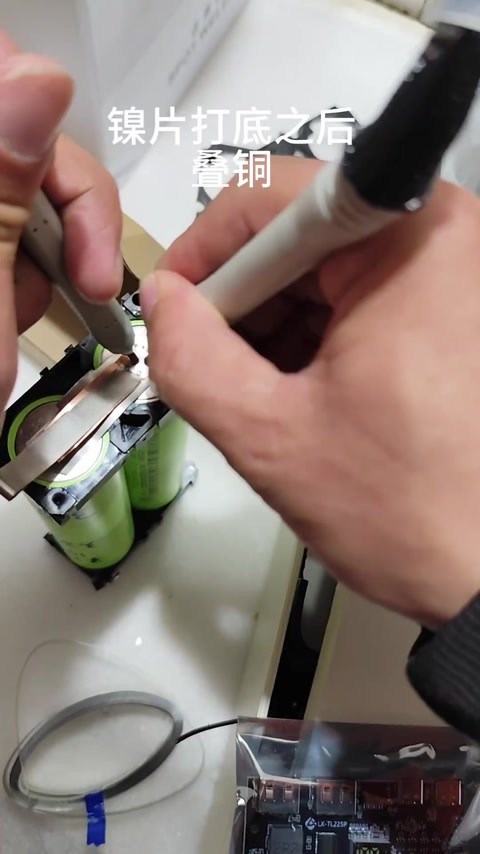
A follower asked whether the UF20B can weld copper stacked directly, I said no, he said support says it can with flux, so here’s the video, see for yourself. The four Jiashikai cells torn down last time (the leaky group out of the 15S is discarded), BMS and charge module not removed, bought a new LiFePO4 board with more ports; two Jiashikai in parallel for a power bank, 30,000 mAh; into the holder in parallel, 3.2V output, spot weld + to + and − to −; many previous copper-and-nickel weld marks on top; switch on the UF20B, charges quickly, try to charge it full before welding; copper 0.1, nickel 0.12 (maybe 0.1, no more than 0.12); added a braided sleeve to the lead himself, No. 6 lead; preheat 10, (interval) 20; straight on first: 0.1 copper + 0.1/0.12 nickel-plated, gear 40 → 70 (dangerous, don’t imitate, same unit as in the showcase): spots are OK but a tug shows they’re not solid, ‘so I don’t recommend copper straight on’; up to gear 90 with four spots, pretty spots but still not solid, don’t recommend stacking copper directly on this model. Next, nickel base: 0.15 nickel-plated steel strip as the base, with experience gear 30 is already very solid (a bit dark, current is high); 0.15 strip at gear 40 tears; up to gear 60 blows two holes; then 0.1 copper on the base: can’t be pulled, can’t be pulled off, clearly far more solid than straight onto the cell; with this model a nickel base works, straight on is not recommended, a thinner strip might stack. After welding, main + / − soldered to B+/B−, an epoxy board sealed on top and glue poured everywhere else; the power bank works, 93% charge; case closed, OK; the two Jiashikai cells sit inside like a single big cell, fast charge, charge board ¥20-odd, wrap with tape; 30,000 mAh, more than enough for food delivery. 68 comments: cells can’t be torn down over and over, three times and they’re basically done; music too loud; will a single layer of 0.3 nickel do; 0.15 copper under, 0.2 nickel-plated on top, weld directly?; can this machine do a 0.2 nickel base; pure nickel costs more than copper strip and doesn’t spark; only this episode showed me copper straight on isn’t stable; 32140 1P16S without a BMS?
Outcome
| Goal | Test UF20B copper straight on vs nickel base; build a 2P Jiashikai 30000mAh power bank along the way |
| Build | UF20B (No. 6 pen) + 0.1 copper + 0.1/0.12/0.15 nickel-plated + 2 × Jiashikai + LiFePO4 power-bank board |
| Result | Straight on at gear 70/90 not solid; 0.15 base at gear 30–60 solid; power bank done, 93% · verified on camera: Straight-on welds pulled off at 193–260s; base welds can’t be pulled at 344–360s; power bank working at 415–428s |
Steps7 steps · click a frame to jump
 1. Background: support says copper can go straight on; two Jiashikai + new LiFePO4 board for a 30,000 mAh power bank
A follower says support says the UF20B can weld copper directly with flux; four cells torn down last time, the leaky one from the 15S discarded; new LiFePO4 power-bank board with more ports; two Jiashikai in parallel for 30,000 mAh.
00:00 – 01:08 2. Discard the leaky group; into the holder in parallel, 3.2V, + to + and − to −; charge the UF20B full before welding
Remove the leaky one from the 15S; take the two with slightly higher IR for the power bank; into the holder in parallel, 3.2V output, spot weld + to + and − to −; many earlier weld marks; switch on the UF20B, charges quickly, try to charge it full before welding.
01:08 – 01:58 3. Copper straight on: 0.1 copper + 0.1/0.12 nickel-plated, preheat 10 interval 20, gear 40 → 70: spots OK but not solid
Copper 0.1, nickel 0.12 or 0.1; No. 6 lead with braided sleeve; preheat 10, interval 20; gear 40 straight to 70 (dangerous, don’t imitate, same unit as in the showcase); spots OK, a tug shows not solid; so copper straight on is not recommended.
02:02 – 03:38 4. Up to gear 90, four spots: pretty but still not solid — don’t stack copper directly
Gear 70 can go higher, add 20 to gear 90; four spots, very pretty but not solid; don’t recommend stacking copper directly with this model.
03:38 – 04:20 5. Nickel base: 0.15 nickel-plated at gear 30 already solid (slightly dark), gear 40 tears, gear 60 blows two holes
0.15 nickel-plated steel strip for the base, with experience no need to go high, gear 30 is very solid; current a bit high, a bit dark; 0.15 strip at gear 40 tears; up to gear 60 blows two holes.
04:20 – 05:43 6. 0.1 copper stacked on the nickel base: can’t be pulled, clearly solid; verdict
See the 0.1 on the nickel base: can’t be pulled, can’t be pulled off, clearly far more solid than straight onto the cell; with this model a nickel base works, straight on not recommended, a thinner strip might stack.
05:44 – 06:23 7. Connect B+/B−, seal with epoxy board + glue; 93%; close the case; like a single big cell super-fast-charging 30,000 mAh power bank
After welding, main + / − soldered to B+/B−; epoxy board sealed on top, glue poured elsewhere; power bank works, 93%; case closed OK; two Jiashikai like a single big cell; fast charge; charge board ¥20-odd; wrap with tape; 30,000 mAh, more than enough for food delivery.
06:31 – 07:47
Bill of materials
| Jiashikai 32140 (salvaged) ×2 | Leaky cell discarded · 2P power bank |
| LiFePO4 power-bank board ×1 | ¥20-odd, many ports · Charge / discharge |
| UF20B + No. 6 pen (braided-sleeve lead) ×1 | Stacked-weld test |
| Copper strip 0.1 / nickel-plated 0.1, 0.12, 0.15 | Straight on vs nickel base |
| Holder / epoxy board / glue / tape | Structure and sealing |
Measured on camera
| Power bank charge level | 93 % 06:57 |
Creator’s tips
- Stacking copper on the UF20B needs a nickel base: 0.15 nickel-plated at gear 30 is solid, 0.1 copper on top can’t be pulled; copper straight on won’t hold even at gear 90 03:22
- Charge the machine full before spot welding 01:58
- After connecting main + / − to the board, seal with epoxy board + poured glue 06:37
Pitfalls
- Support’s ‘copper straight on with flux’ claim doesn’t match the test 03:22
- High gears blacken / tear the base nickel strip 05:05
- Comments: cells torn down three times are basically done; BGM too loud
Li-ion safety
- Gear 70/90 ‘dangerous, don’t imitate’ 02:46
Quotes
Cost & time
| LiFePO4 power-bank board | ¥20 · ¥20-odd |